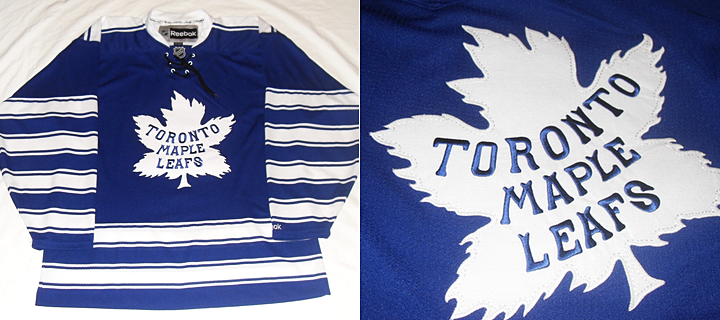
Leafs' Winter Classic Jersey Leaked?

TheHockeyJersey.co via ebay

Apparent unreleased Leafs jersey shows up on ebay

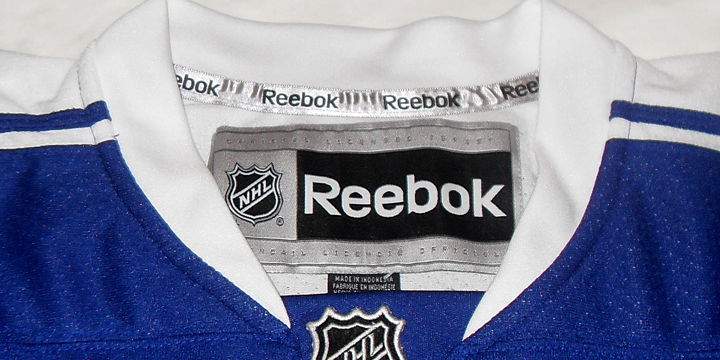
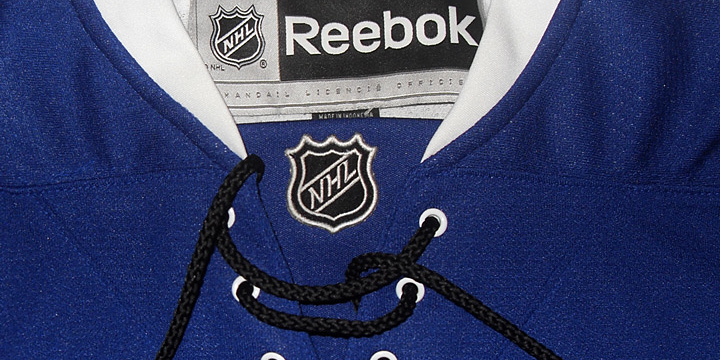
A product listing on ebay appears to show a legitimate Toronto Maple Leafs jersey, intended for the 2013 NHL Winter Classic. The game was canceled so uniforms were never released or even unveiled. That being said, it was canceled pretty late in the year, meaning merchandise like this was certainly already produced.

Last month, a couple of leaked T-shirt designs showed the same logo crest.

TheHockeyJersey.co via ebay

Seeing something like this tends to make us all skeptical. And I'd venture to say I fly the skeptic flag higher than anyone else when it comes to these things. So the fact that I'm taking the time to post this should tell you something.

But more important than whether this is a real jersey or not is the fact that, if it isn't, it's by far and away the most convincing counterfeit I have ever seen. And it would mean counterfeiters are getting scary good. So good, in fact, that it's impossible to tell the difference between real and fake. Which is why I believe this is probably the real thing.

The seller is TheHockeyJersey.co and the rest of their product catalog appears to be legitimate. However, I doubt they're officially licensed by the NHL. Because if they are, they won't be for much longer. But drop by their page, take a look at the high-resolution photos on the auction listing and judge for yourself.

Thanks to Doug B. for the tip.

So... real or what?

Hockey Talks Across Canada

Canada's seven NHL franchises are taking part in a mental health initiative throughout the month of February. Among other things, it involves the players wearing special helmet decals for select games throughout the month. Each team will host a Hockey Talks game night, led by the Vancouver Canucks back on Feb. 1.

The Toronto Maple Leafs picked up the torch the following night on Feb. 2.

Last Wednesday, it was the Montreal Canadiens doing their part on Feb. 6.

The next night, on Feb. 7, it was Hockey Talks night for the Winnipeg Jets.

The other three teams will host their Hockey Talks nights next week, beginning with the Calgary Flames on Thursday, Feb. 20.

The Edmonton Oilers follow up with their hosting duties on Feb. 21.

And finally, things wrap up in Canada's capital city on Feb. 23 when the Ottawa Senators host the Leafs for the final Hockey Talks game night of the month.

By the way, take a close look at each of these seven logos. They're not as generic as they seem. The type is all set in the same font the Vancouver Canucks use for their wordmarks and jerseys. And the hockey stick in the middle, it's from the Canucks' secondary logo.

I know this campaign has a lot to do with Rick Rypien, so it makes sense the Canucks marketing team would take the lead on designing the logos. It's just interesting to see Canucks branding incorporated into that of all the other Canadian clubs.

Not that any of that matters. This is an important issue and it still would be regardless of any silly logos. It's nice to see Canadians trying to take care of their own. We could learn a thing or two about that down here.

Solar Bears Roll Back the Clock

Photos provided by Orlando Solar Bears

Twelve years is a long time to wait for something. Orlando hockey fans had to wait that long to watch their championship banner be raised to the rafters. Last Saturday, Feb. 2, the ECHL's Orlando Solar Bears paid tribute to their IHL predecessors by celebrating their 2001 Turner Cup championship.

But the interesting thing to us jersey geeks is what the Solar Bears wore while doing it. The team broke out the old Solar Bears jerseys for the special night — complete with the upper/lowercase surnames and everything! Those uniforms looked great from 1996 to 2001 and they look great now.

Photos: ©2013 Gary Bassing/OSB via Solar Bears official Facebook page

Great to see the new Solar Bears honoring the old Solar Bears. You can find a lot more pictures on the team's official Facebook page.

Arena Logos: The AHL West

Two weeks ago, I put NHL arena logos on display just for fun. This weekend, we're taking a look at what the AHL has to offer in this area. Yesterday, it was the rink in the Eastern Conference. Today, the Western Conference. Enjoy.

Abbotsford Entertainment & Sports Centre opened in 2009 in Abbotsford, B.C. — and just a few months later, it became home to the Abbotsford Heat. The Heat are the latest incarnation of a franchise that has been rather nomdic over past decade, relocating every few years. After leaving Saint John, New Brunswick in 2003, the club played in Omaha, Neb. and Moline, Ill. before arriving in British Columbia.

The Time Warner Cable Arena was built for the NBA. In fact, when it opened in 2005, it was called the Charlotte Bobcats Arena. But back then, the Charlotte Checkers were an ECHL franchise and shared the arena with the Bobcats. That team was dissolved in 2010, however, when the AHL's Albany River Rats moved to North Carolina and assumed the Checkers nickname. Time Warner Cable bought the naming rights in 2008 and changed the logo as part of a 2010 corporate rebranding.

Located in Rosemont, Ill., just outside of Chicago, is Allstate Arena — known as Rosemont Horizon from its opening in 1980 until 1999. It's been home to the Chicago Wolves since their entry into the International Hockey League in 1994. The Wolves transferred to the AHL when their original league went belly up in 2001.

The story of Van Andel Arena in Grand Rapids, Mich. is not unlike that of Allstate Arena. It began life in 1996 housing IHL hockey in the form of the Grand Rapids Griffins. Like the Wolves, the Griffins joined the AHL in 2001 where they still play today.

Copps Coliseum has hosted Hamilton Bulldogs hockey for the past 20 years. But it hasn't always been the same franchise. The original Bulldogs arrived from Sydney, Nova Scotia in 1996 but left in 2002 to become the Toronto Roadrunners. However, at the same time, the Quebec Citadelles moved in and became the new Bulldogs. So as far as fans are concerned, their team hasn't missed a beat. 

But there's a pre-Bulldogs history to include. The Coliseum opened in 1985 where it hosted OHL junior teams until 1991. The AHL's Hamilton Canucks were formed in 1992 but moved to Syracuse, N.Y. after only two seasons. The Bulldogs entered the picture two years after that.

There's a bit of trouble brewing at Toyota Center in Houston, Texas. At the end of this season, the lease is up for the Houston Aeros and negotiations for a new one are not going well, according to the Houston Chronicle. No decisions have been made yet, but if a deal isn't done, it could spell the end of a long run of minor league hockey in Houston. 

The Aeros were founded in 1994 in the IHL and joined the AHL in 2001. Since 2003, they've played at Toyota Center, which is operated by the NBA's Houston Rockets. They are the building's primary tenant.

I'm sure you're noticing a lot of Western Conference AHL teams sharing buildings with the NBA. The Lake Erie Monsters are another example, as they've split time at Quicken Loans Arena with the Cleveland Cavaliers since 2007. The Q opened in 1994 as Gund Arena, housing the Cavaliers and the IHL's Cleveland Lumberjacks. The Jacks did not survive the dissolution of the league in 2001, but were immediately replaced by the AHL's Cleveland Barons — who moved from Lexington, Kentucky. They then moved to Worcester, Mass. in 2006.

Another story you've heard a few times before in this post with just a few names changed. The BMO Harris Bradley Center (just the Bradley Center prior to the 2012 naming rights purchase by BMO Harris) houses the AHL's Milwaukee Admirals as well as the NBA's Milwaukee Bucks. It opened in 1988 with both of these teams as founding tenants — though the Ads were members of the IHL at the time.

The Cox Convention Center opened in 1972 as "The Myriad" and has hosted numerous hockey teams over the years. The Oklahoma City Blazers of the Central Hockey League did two stints, 1973—1977 and 1992—2002 and there was even a season of roller hockey in 1995 — the Oklahoma Coyotes. However, since 2010, the Oklahoma City Barons have been the prime resident. 

The Peoria Civic Center is part of a complex that includes Carver Arena, home to the Peoria Rivermen since arriving from Worcester, Mass. in 2005. But the Civic Center opened in 1982 and has always hosted some form of pro hockey. The Peoria Prancers were founded in 1982 and changed their name to Rivermen in 1984. In 1996, they moved to San Antonio, Texas but were replaced by a new ECHL team, also called the Rivermen, until the 2005 arrival of the AHL.

In downtown Rochester, N.Y., you'll find Blue Cross Arena at the War Memorial. Don't let the glass façade fool you; it was built in 1955 but got a major renovation in 1998 when Blue Cross picked up the naming rights. In all that time, it's been home to the Rochester Americans

Look familiar? BMO Harris Bank owns the naming rights to not one, but two AHL rinks. Along with the Bradley Center in Milwaukee is BMO Harris Bank Center in Rockford, Ill. The arena opened in 1981 but didn't host hockey until 1999 when the UHL's Rockford IceHogs were founded. They went out on top, winning the 2007 UHL championship before being replaced by the AHL. The Cincinnati Mighty Ducks franchise had been re-established but failed to meet a season ticket sales goal, so the team relocated to Illinois and adopted the IceHogs moniker.

The AT&T Center opened in 2002 as the new home of the NBA's San Antonio Spurs, but at the same time, earned the city a brand new hockey team. The dormant Adirondack Red Wings franchise was re-established in Texas as the San Antonio Rampage.

One of the newer arenas in the AHL is the Cedar Park Center in Cedar Park, Texas — home of the Texas Stars. The Stars were the building's founding tenant and its reason for being built. Prior to 2009, the club was based in Des Moines, Iowa, first as the Iowa Stars, and later the Iowa Chops.

And finally, the Toronto Marlies have called Ricoh Coliseum home for all of their eight years of existence. But the building itself has been around since 1921! It was renovated in 2003 and its first tenant was the Toronto Roadrunners, who the Edmonton Oilers had just moved out of Hamilton, Ont. The NHL club then moved their affilate geographically closer to them (to Edmonton) the following season and suspended operations a year after that.

The Marlies moved from St. John's, Newfoundland in 2005 after a season without hockey at the Coliseum. The arena was formerly known as Civic Arena and CNE Coliseum prior to Ricoh buying the naming rights in 2003 after the renovation.

Hope you found these posts at least half as interesting as the NHL arena posts.

Arena Logos: The AHL East

These posts on arena logos have been getting pretty decent feedback from you guys. So I figured I'd go ahead with a look at rinks from around the American Hockey League. We'll start with the Eastern Conference today and focus on the other half tomorrow.

We begin with the 34-year-old Glens Falls Civic Center, the temporary home of the Adirondack Phantoms — and former home of the Adirondack Red Wings for two decades. When the Spectrum was closed in 2009, the Philadelphia Phantoms were forced to find a new place to play. They headed up to Glens Falls, N.Y. but the plan was always to return to Pennsylvania. In time for the 2014-15 season, the team will depart Glens Falls for a new building in Allentown, Penn. where they'll be renamed the Lehigh Valley Phantoms.

The Times Union Center in Albany, N.Y. has hosted pro hockey since it opened in 1990 and is currently home to the Albany Devils. The fun started with the Albany Choppers of the IHL at a time when the building was named Knickerbocker Arena. But the IHL club was terrible and got run out of town after one season by a new nearby AHL team, the Capital District Islanders.

In 1993, the Islanders got a new owner who moved them into the Choppers' old building. They were renamed the Albany River Rats and endured two renamings of their building over the years — Pepsi Arena in 1997, and ultimately, Times Union Center in 2007. The River Rats moved to North Carolina and became the Charlotte Checkers in 2010. At the same time, the Lowell Devils left Massachusetts and ensured that Albany would continue to host AHL hockey.

The Broome County Veterans Memorial Arena doesn't have a terribly exciting name or logo, but that's par for the course when you're talking about 40-year-old buildings owned by municipalities. The Binghamton Senators haved played here since 2002 but they're far from the first. Hockey came to Broome County by way of the NAHL's Broome Dusters (clever) when the arena opened in 1973.

Four years later, they were replaced by the AHL when the Rhode Island Reds arrived in 1977 and became the Binghamton Dusters. The team was renamed Whalers in 1980 and Rangers in 1990. (Think you can probably track the NHL affiliation changes there.) In 1997 — after a 20-year run — the team left for Connecticut where they became the Hartford Wolf Pack.

During their five years without the AHL, Binghamton turned to the United Hockey League. Enter the B.C. Icemen (that's B.C. for Broome County, not British Columbia, of course). But they went away when the Prince Edward Island Senators franchise was re-established in Binghamton after a six-year hiatus.

Here's a modern-looking AHL arena logo. The Bridgeport Sound Tigers were the founding tenant of The Arena at Harbor Yard in 2001. Webster Bank bought the naming rights in 2011.

Remember the Binghamton Dusters from earlier? They're the Connecticut Whale now and host opponents at XL Center in Hartford, Conn. — a building that once housed NHL and WHA hockey. The Wolf Pack, as they were known then, arrived in 1997 to fill the void left by the Hartford Whalers, who moved to North Carolina.

The arena opened in 1975 as the home of the WHA's New England Whalers but the roof collapsed in 1978 and closed for a couple of years. By the time the building reopened, it was for NHL hockey. The naming rights were purchased in 2007 by XL Group, a financial services company. But that contract runs out later this year.

The Giant Center houses one of the AHL's oldest franchises, the Hershey Bears. It opened in 2002 in Hershey, Penn. and never looked back. Prior the move, the Bears played at Hersheypark Arena which is approaching its 80th birthday. But the team still uses that rink to practice.
Manchester, N.H. is where you'll find Verizon Wireless Arena and its sole tenant, the Manchester Monarchs. The team was founded in 2001 just in time to open the new building.

This one is a little tricky. The Norfolk Admirals technically play at Scope Arena in Norfolk, Va. — a building that opened in 1971. But the arena is part of a larger complex of venues, now known as Seven Venues — which uses the above logo. And I haven't been able to track down a current version of the Scope logo, if one even exists. Could definitely use a hand if there are any locals that can help out. The Ads have played at Scope since their inception in 1989.

The Cumberland County Civic Center is located in Portland, Maine. It opened in 1977 and has housed AHL hockey for all but one year since. In 1993, the CCCC welcomed the Portland Pirates to town from Baltimore, Md. but before that, the original tenant was the Maine Mariners. They departed for Rhode Island in 1992 where they currently exist as the Providence Bruins. 

Hey, speaking of the Providence Bruins! The Bruins call the Dunkin' Donuts Center home, but only since their arrival in 1992. The building has a much longer history. It was simply the Providence Civic Center when it opened in 1972 as the second home of the Providence Reds (who would later become the Connecticut Whale, see above). That team left for Binghamton in 1977, which left a 15-year gap without pro hockey in Rhode Island's capital city.

The newest member of the AHL arena party is the Mile One Centre in St. John's, Newfoundland — but it's not their first rodeo. After a three-year absence, it returned to the hockey fray in 2011 with the arrival of the Manitoba Moose, who were booted from their home by the new Winnipeg Jets. Once in Newfoundland, they became the St. John's IceCaps.

The Mile One Centre opened in 2001 as the new home of the St. John's Maple Leafs, who arrived from Newmarket, Ont. in 1991. They went back to that province in 2005 and became the Toronto Marlies. From there, the arena was home to the QMJHL's St. John's Fog Devils, who left in 2008 for Montreal and eventually became the Blainville-Boisbriand Armada in 2011.

Opened in 1972, the Springfield Civic Center has always been a place for hockey. And like Hartford's XL Center, it has the distinction of hosting NHL action for a time. Remember how XL's roof collapsed in 1978? Springfield, Mass. is where the Whalers played during renovations — and made their transition from WHA to NHL.

The Springfield Kings became the first resident of this arena in 1972 after leaving the aging Eastern States Coliseum, or The Big E. They were originally the Indians when founded in 1926 and switched back to that moniker in 1974. But two decades later, the team was sold and moved to Worcester, Mass. where they became the IceCats. Today, that team is the Peoria Rivermen.

In 1994, the AHL expanded to fill the gap left by the Indians' departure. Enter the Springfield Falcons we now know. And in 2005, the Massachusetts Mutual Life Insurance Company bought the naming rights to the building, today called MassMutual Center.

All right. Worst. Arena logo. Ever. Certainly the most corporate one I've ever seen. Syracuse, N.Y.'s War Memorial Arena is part of a group of venues collectively known as The Oncenter. Each has an indistinctive logo like this with varying icons on the left. Not impressed. But the Syracuse Crunch call it home.

The building itself has a long history, having opened way back in 1951. It may actually be the oldest AHL building still in use today. It's housed five different hockey teams over the years, but the Crunch arrived in 1994 after 14 years without the sport. Prior to that, the franchise played two seasons in Ontario as the Hamilton Canucks.
The Mohegan Sun Arena at Casey Plaza (in Wilkes-Barre, Penn.) opened in 1999 and re-established a dormant AHL franchise that had been affiliated with the Quebec Nordiques for 15 years. Last known as the Cornwall Aces in 1996, the Wilkes-Barre/Scranton Penguins began play when the building was called the Northeastern Pennsylvania Civic Arena and Convention Center.

A year after it opened, the naming rights were purchased by First Union. (Oh no, bank flashbacks!) And as we learned a couple weeks ago, First Union became Wachovia in 2003. The contract on Wachovia Arena at Casey Plaza ended in 2010 when Mohegan Sun at Pocono Downs took up the flag.

We finish today with the home of the Worcester Sharks — and yet another building named for a financial institution, the DCU Center. Digital Federal Credit Union paid for naming rights in 2004, two years before the Cleveland Barons relocated to Massachusetts. The building opened in 1982 as the Centrum in Worcester (and later the awful Worcester's Centrum Centre in 1997) but it hasn't always had hockey. The AHL was housed from 1994 to 2005 after the Springfield Indians moved and became the Worcester IceCats.

That's all for today. We'll get to the west tomorrow. (Ha, see what I did there?)